
Excavation 2025
This year's excavation campaign took place from 23 August to 15 September and was carried out in collaboration with the teaching excavation of the Institute of Classical Archaeology at the University of Vienna.
This year, the excavations focused on the architectural structures north of the church complex and on the western area of the church court (Atrium).
The excavation in F07
Area F07 extends along the façade of the southern church building in the south-west over an area of approximately 8 x 4 m. It connects to the two passageways from the southern nave in the east and extends across the southern part of the court (atrium).
Excavation area F07 with the southern nave in the background.
During the excavations in the court, another room was uncovered in the southern area. This later addition is connected to each, the church and the court (atrium), by a passageway. At some unknown point in time, the passageway towards the court filled with loose, clay-bound quarry stones and sealed. The room itself is rather plain, with remnants of monochrome beige plaster and rectangular stone floor slabs.
In the north-eastern corner of the room, some floor slabs had been removed and replaced with fragments of taegulae.
A grave with a single burial was uncovered beneath the floor slabs.

Southern room in F07.
While excavating in the wider area of F07 to the north, several layers of burnt material and two further boundary walls to the west were uncovered and documented. Like the masonry in the southern room, these two walls do not appear to be part of the original atrium. The court, which is connected to the church by a central passageway, is paved with large rectangular stone slabs. The exposed exterior façade of the church still has some remains of white plaster.
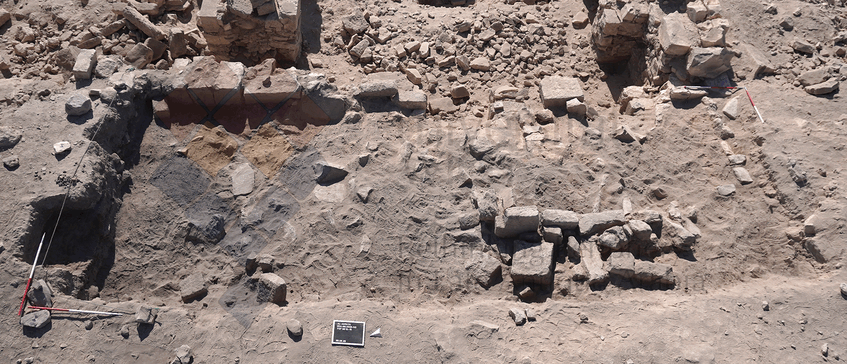
Two large gaps in the western part of the floor allowed for test pits to be dug. Three graves with multiple burials were uncovered and documented.

Area F07, northern section.
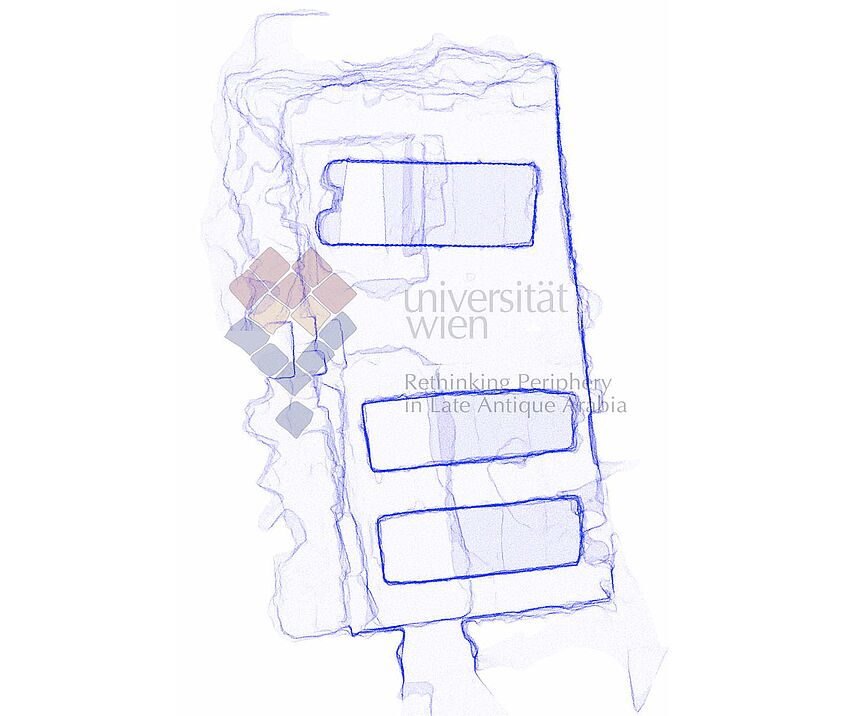
The three graves in the northern area under the church forecourt (F07)
The excavation in F08
The excavation area F08 was set up along the partially collapsed northern church wall towards the north, i.e. on the side facing away from the church building. Due to the desolate condition of the inside of the north wall, it has only been partially exposed so far in order not to accelerate further decay. However, due to this safety measure, it was not possible to clarify whether there were connections between the church and the building complex to the north during the excavations inside of the church (F05, 2023). The excavations in area F08 were intended to remedy this situation and help clarify the relationship between the two building stuctures.

Area F08 north of the church complex (F05, 2023)
During excavations in this northern building complex (F08), an entrance area, several rooms (partially) and a central room (completely) were uncovered.
The building, which is located uphill above the church, has a simple stone slab floor and a higher floor level than the church. Low pillars with arch bases were also uncovered and documented in the rooms.
In order to clarify the relationship between the two structures more precisely, a test pit was dug along the outside of the church's north wall. This allowed the church wall with its external supporting pillars to be uncovered down to its foundations.
ṭābūn (F07)
During the excavations in F07, a complete ṭābūn preserved in situ was uncovered, documented and sampled along the northern edge of the section. The sampling, flotation and evaluation of the results is being carried out by our project partners Annette Hansen and Frits Heinrich from the Vrije Universiteit Brussel (Department of History | Research Group Interdisciplinary Historical Food Studies; Department of Bioengineering Sciences | Research Group Industrial Microbiology and Food Biotechnology IMDO).

3D video of the stratigraphic exposure of the ṭābūn (F07)